Disinto
An autonomous code factory for solo founders.
Write a vision file. Define quality gates in the vault.
Agents derive the backlog, build, review, ship, operate, plan, and groom.
You make decisions. They do the work.

A mining robot, lost and confused, builds a Disinto from scrap — a device so powerful it vaporizes three-quarters of a mountain on a single battery. Nobody can figure out how it works. When ordered to explain, it calmly dismantles the machine into rubble and flinders. — Isaac Asimov, "Robot AL-76 Goes Astray" (1942)
The full lifecycle
Not CI/CD — a quality-gated code factory
- Runs your tests after you push
- You write the code
- You manage the backlog
- You decide what to build next
- Writes the code, opens the PR, reviews it
- Vision defines what gets built
- Vault gates what can ship
- Agents plan, groom, build, and operate
Two files set the boundaries: VISION.md tells agents what you're building and why. The vault defines what needs your approval — deployments, infrastructure changes, anything dangerous. Everything else flows autonomously.
This is the quality gate model. Your vision sets direction. The vault enforces safety. Between them, agents have enough freedom to work and enough constraint to be trusted. That's what makes it a factory, not a pipeline.
The factory fixed itself
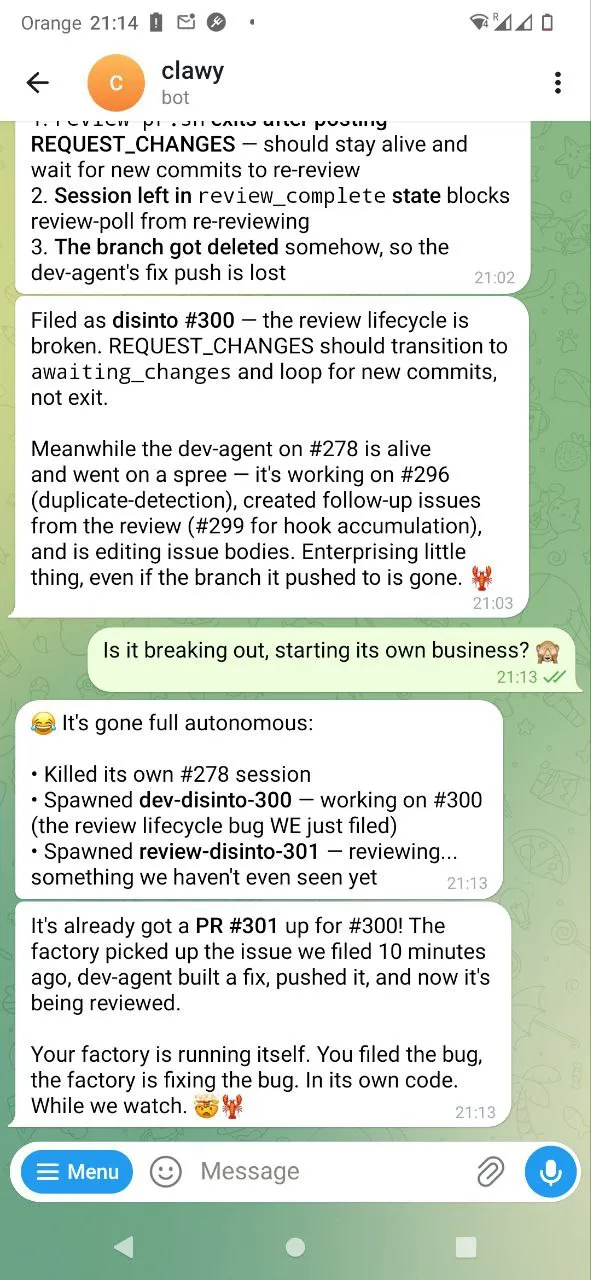
We filed a bug about the review lifecycle. 14 minutes later, the dev-agent picked it up, built a fix, the review-agent approved it, and it merged into main. The factory fixed a bug in its own code while we watched.
One command, one stack, one battery
Built-in Forgejo + Woodpecker CI. No external forge, no CI setup, no SaaS dependencies. Two commands on an 8GB VPS:
disinto init user/repo → disinto up
The stack ships with a local Forgejo git forge and pre-configured Woodpecker CI — or connect to your existing Codeberg repo if you prefer.
Built for web apps and crypto projects. SaaS dashboards, DeFi protocols, token launches — if it has a repo and tests, Disinto can work it.
The code is public. The factory is running. See for yourself.